

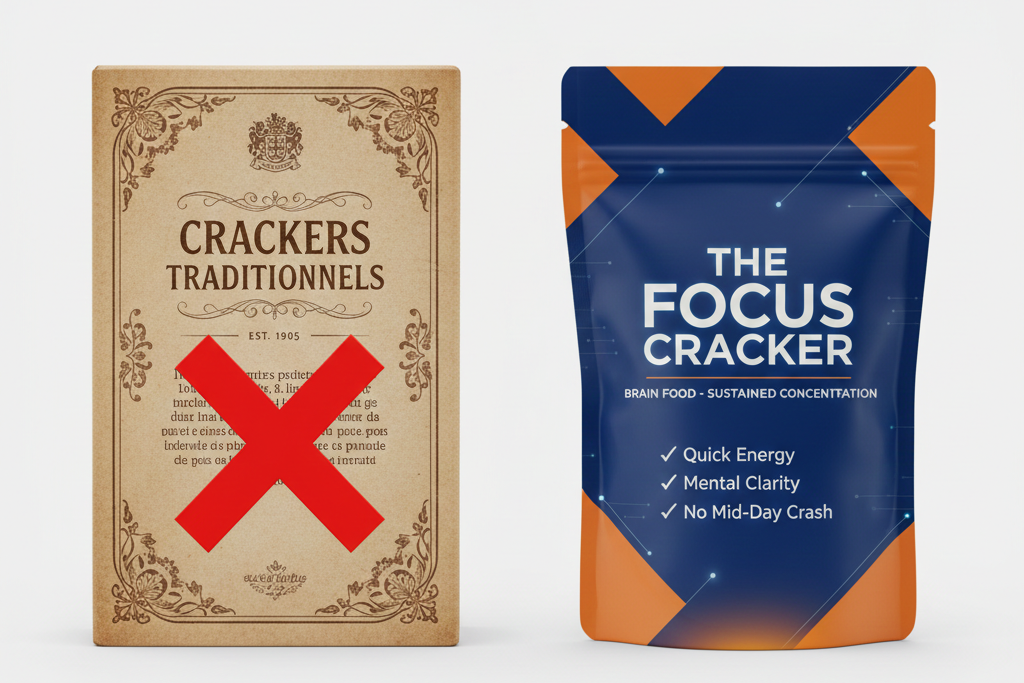
Foreign food brands fail in the U.S. market at an alarming rate. It is rarely due to a poor product. More often, it is because their stories are untethered from American reality. In 2026, high quality is just a baseline—it is a commodity that no longer guarantees a seat at the table.
To win, you must look beyond the lab. You must look past the factory floor. You have to understand the cultural subtext of your American audience.
Success in the U.S. food and beverage sector requires more than shelf space. It requires an intimate understanding of the consumer’s lifestyle rituals. If you don’t adapt, your foreign food brands fail to gain even a foothold.
Is your brand story ready for the U.S. market? Take our Interactive Brand Story Quiz to find out what makes your brand truly unique.
Table of Contents
1. The Heritage Trap: Why Foreign Food Brands Fail Early
The first reason foreign food brands struggle is the “quality blind spot.” Founders often assume a century of success in Europe or Asia translates into instant trust here.
However, the American consumer is looking for a specific cultural resonance. In the U.S., a food product is “hired” to perform a specific task. This follows the Jobs to be Done framework (rel=”dofollow”) developed by the Clayton Christensen Institute.
Consumers might hire a yogurt to survive a 3 PM slump. They might hire a sparkling water to act as a social lubricant. If you only talk about history, your foreign food brands struggle to solve a current problem.
2. Lack of Pattern Recognition in U.S. Retail
Many foreign food brands struggle because they ignore the silent signals of the American grocery aisle. Success here isn’t about being “better.” It is about being interpreted correctly.
The breakthrough for domestic giants usually comes from pattern recognition. They pay attention to how people actually interact with the brand. According to the Harvard Business Review, successful international brands must balance global scale with local meaning.
Without decoding these local patterns, your marketing spend is just expensive guesswork. This is a primary reason foreign food brands struggle to scale.
3. Why Foreign Food Brands Fail Using Literal Translation
Historically, foreign food brands struggle the moment they hire a literal translator instead of a cultural architect. Translation moves words. Transcreation moves hearts.
CSA Research shows that consumers are much more likely to buy when content is adapted to their local culture. When you transcreate, you embed your brand into a daily ritual. A traditional biscuit is just a snack. In the U.S., it must be positioned as the “4 PM Satiety Hero.”
4. The Echo Chamber: How Foreign Food Brands Fail to Adapt
International founders often live in an echo chamber. They are surrounded by agencies that validate their home-market heritage. They rarely challenge its relevance in New York or Los Angeles.
This is precisely where foreign food brands struggle to gain traction. To break free, you need a narrative audit. You need to know how you sound to someone who has never heard of you. If the consumer has to work to understand you, you have already lost.
5. When Foreign Food Brands Fail the Global Myth
Modern consumers look for a “Global Myth.” They want a story that feels international in quality but local in relevance. You cannot copy-paste a campaign from London or Tokyo and expect it to work in the Midwest.
The American consumer is famously pragmatic. They want to know: “What does this do for me right now?” If you cannot answer that, your foreign food brands struggle the ultimate test of relevance.
Stop Guessing. Start Scaling.
The reason foreign food brands struggle is rarely a lack of effort. It is a lack of cultural impact. Don’t leave your expansion to chance.
Before you invest another dollar in U.S. distribution, ensure your foundation is solid. Use our free tool to see how your brand measures up against the competition.